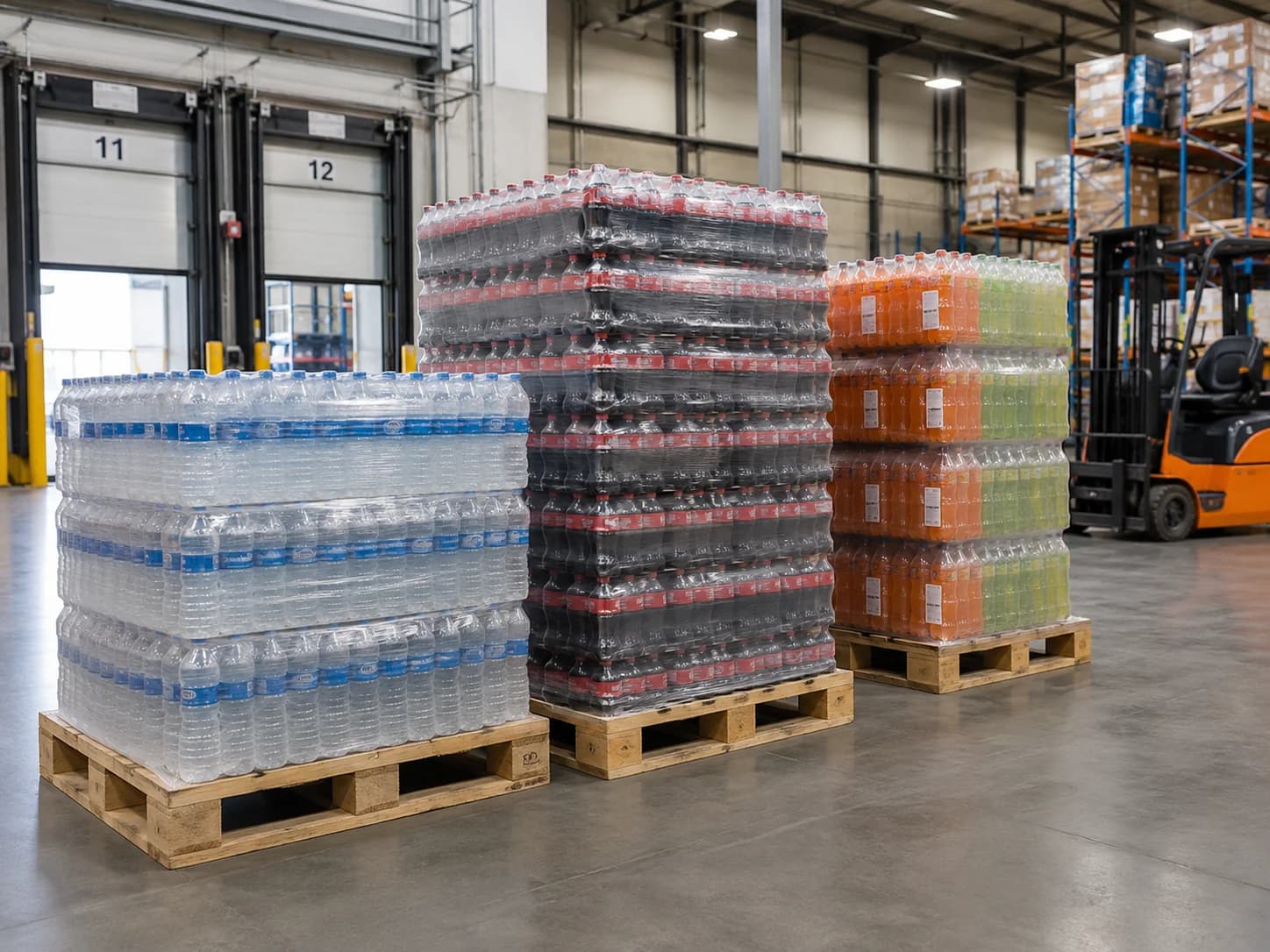
Bottled products are among the toughest items to handle on pallets in the supply chain. Warehouses that move bottled water, juice, soda, cleaning supplies, personal care products, or other liquids handle loads that are dense, heavy, and often moved quickly and repeatedly.
This combination leads to higher risk.
If a pallet is too weak, its deck boards might crack under the weight. Uneven support can cause bottles to shift in transit. When pallet quality changes from one shipment to another, warehouse teams spend extra time fixing unstable loads or working around damaged pallets. In busy operations, even minor pallet issues can quickly escalate into dock delays, freight claims, or product loss.
That is why it is important to choose the right pallets for bottled products. The pallet isn’t only a base; it plays a key role in keeping loads stable, maintaining warehouse flow, and preventing damage.
This guide shows how choosing better pallets can improve stability for dense, fast-moving loads of beverage and consumer goods. It also explains how operations teams can reduce breakage without slowing down their work.
Why Bottled Products Put Extra Stress on Pallets
Not every load behaves the same way in a warehouse or trailer. Bottled products create a unique combination of stress factors:
- high weight concentrated in a compact footprint
- repeated forklift handling through fast-moving operations
- liquid movement that can affect stability in transit
- stacked cases that may shift if the pallet flexes
- frequent turns in retail, beverage, and distribution environments
Bottled product loads are less forgiving than lighter packaged goods. A weak pallet or an inconsistent recycled pallet might look fine on the dock, but once it is lifted, stacked, or shipped, any structural weakness quickly becomes clear.
That is why bottled products need more than just any available pallet. They need pallets that match the operation’s weight and turnover needs.
The Most Common Reasons Bottled Product Loads Fail
When bottled loads become unstable, the cause is often traced back to one of a few pallet-related issues.
1. Deck board failure
Dense loads put repeated pressure on the top deck. If boards are too weak, too thin, or too widely spaced, they can crack or sag.
2. Excessive pallet flex
A pallet that bends too much during lifting can destabilize the stacked cases above it.
3. Stringer damage
Forklift entry and repeated handling wear down the pallet’s structural base, especially in high-turn environments.
4. Inconsistent pallet grades
Mixed quality creates unpredictable performance. Some loads move smoothly, while others require rework.
5. Poor weight support
If the pallet does not evenly support the load, the cases above can shift, lean, or lose compression strength.
All of these problems increase the risk of product damage, slow warehouse operations, and create freight issues.
What Good Pallets for Bottled Products Need to Do
A strong pallet program for bottled products should support four things at once:
- weight
- stability
- handling speed
- consistency
This might sound simple, but in reality, it means coordinating the pallet design to how these loads move through the warehouse.
High load-bearing strength
Bottled products are heavy, even when packaged efficiently. Pallets need sufficient structural strength to withstand both static and dynamic loads without cracking or collapsing.
Reduced deflection during lifts
When pallets bend during forklift moves, the load stack can become unstable. Stronger construction helps keep the load tighter and safer.
Consistent quality across shipments
Busy, high-turn operations do not have time to sort through mixed-quality pallets during a shift.
Reliable support under repeated use
In beverage and consumer product distribution, pallets are often handled many times. That is why durability is important.
Why Deck Design Matters for Dense Loads
One of the most important structural features in pallets for bottled products is the deck.
When bottles packed in cases are stacked in layers, the load may appear evenly distributed, but the pressure on the pallet remains high. If the deck spacing is too wide or the boards are not in good shape, the pallet might not support the load evenly.
A stronger deck design helps by:
- improving weight distribution
- reducing board cracking
- minimizing sag under heavy cases
- advancing overall unit-load stability
This is especially important when bottled loads are stacked several layers high or stored for a while before shipping.
How High-Turn Environments Change the Pallet Requirement
A pallet that works in a low-volume warehouse may not perform well in a high-turn distribution center.
Bottled product operations often move pallets through:
- rapid receiving
- staging
- putaway
- picking or load building
- outbound loading
- retail or route distribution
All this repeated movement causes more wear. Forklift entry points get weaker over time, and stringers take repeated hits. If there are no clear sorting standards, damaged pallets are more likely to stay in use.
In these settings, pallets should be picked not just for a single trip, but to handle repeated use and stress.
That is why many high-turn warehouses benefit from pallet programs that focus on:
- reliable recycled grades
- regular inspection
- removal of damaged units
- scheduled replenishment to prevent overuse of weak pallets
The Role of Recycled Pallets in Bottled Product Shipping
For many beverage and consumer packaged goods operations, recycled wood pallets are the most practical choice.
They offer:
- lower cost than new pallets
- strong availability in high-volume markets
- repairability and reuse
- solid performance for most domestic bottled product freight
However, recycled pallets only perform well when grading standards are carefully managed.
If the pallet supplier provides inconsistent loads, operations may see:
- greater variation in strength
- more deck failures
- more time spent reworking loads
- reduced confidence in outbound stability
That is why the way a supplier grades pallets is just as important as the type of pallet used.
When New Pallets May Make More Sense
While recycled pallets suit many bottled product operations, there are cases where new pallets are the better choice.
For example:
- export shipments requiring more uniformity
- high-value retail presentation
- automated warehouse systems sensitive to variation
- loads where exact dimensional consistency matters
New pallets offer a more uniform structure, which can make performance more predictable. Still, many operations find that a well-managed recycled-pallet program delivers better overall value for most bottled products.
The best answer frequently depends on the shipment type, not just the product category.
Why Stability in Transit Matters So Much
Bottled products are often shipped in dense, stacked loads that seem secure at first but can become unstable during transport.
While in transit, loads experience:
- vibration
- braking
- acceleration
- turns
- repeated handling between facilities
If the pallet beneath the load flexes or moves, the stacked cases above are more likely to lose alignment. That can lead to:
- leaning loads
- crushed packaging
- broken bottles
- spill damage
- rejected shipments or freight claims
A stronger pallet base helps the whole load stay together as one stable unit.
Warehouse Flow Improves When Pallet Quality Is Predictable
Pallet performance also affects warehouse labor.
When bottled product loads are built on reliable pallets, warehouse teams spend less time:
- replacing broken pallets
- re-stacking unstable cases
- sorting around inconsistent inventory
- dealing with avoidable damage at the dock
This leads to better throughput and fewer interruptions.
For operations handling large volumes of bottled products, using consistent pallets improves both freight performance and warehouse efficiency.
How to Reduce Breakage in Bottled Product Loads
A stronger pallet program usually comes down to a few practical controls:
Use the right pallet grade consistently.
Do not mix heavily worn pallets into high-turn, high-weight bottled product flow.
Inspect pallets before they enter the active load-building area.
Remove cracked, warped, or structurally questionable pallets early.
Match pallet strength to actual load weight
Do not assume standard pallets are always enough for dense bottled goods.
Keep scrap and reusable pallets separated.
Good yard control protects usable inventory and reduces the risk of surprise failures.
Work with a supplier that can support consistent replenishment.
That prevents the operation from reusing weak pallets longer than it should.
These changes are not dramatic, but they have a significant impact on load quality and daily operations.
Better Stability Starts at the Base
Bottled product loads may look simple because the cases stack evenly. However, under that neat appearance is a heavy, high-pressure, fast-moving load that relies on the pallet below.
The right pallets for bottled products help operations:
- support more stable load building
- reduce breakage and damaged cases
- improve forklift handling performance
- maintain speed in high-turn warehouse environments
- lower the risk of freight claims and rework
This is why choosing pallets is an operational decision, not just a purchasing choice.
Contact The Pallet Squad
If your operation needs reliable pallets for bottled products, contact The Pallet Squad. We offer consistent wood pallet supply, delivery, pickup, and recycling services designed for high-turn, dense loads.