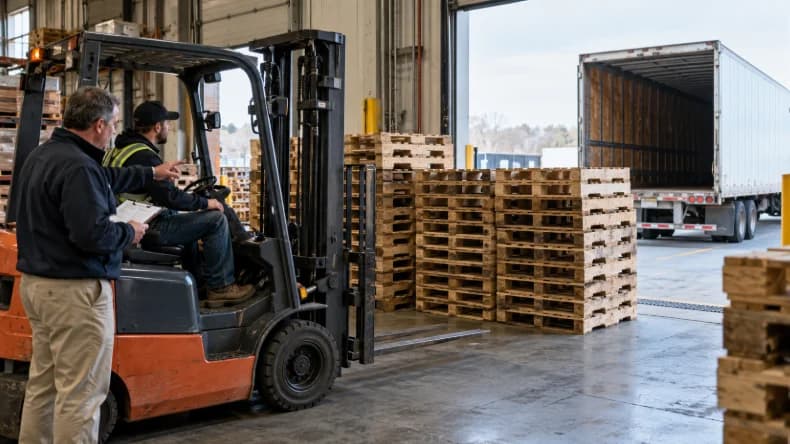
If your warehouse regularly ends up with excess wood pallets, the choice between a drop trailer vs pallet pickup usually comes down to volume and frequency. Scheduled pallet pickup works well when pallets accumulate occasionally or your team has enough room to stage them between collections. A drop trailer makes more sense when pallets keep showing up throughout the week and your warehouse needs a permanent place to put them.
At The Pallet Squad, we handle both commercial pallet pickup and drop trailer pallet recycling for businesses nationwide. Neither setup is automatically better. The right one depends on what your warehouse is dealing with every week.
Drop Trailer vs Pallet Pickup: What’s the Difference?
With scheduled pallet pickup, your facility holds excess pallets in an approved staging area until removal. Pickup may be one-time or recurring depending on how often your operation generates unwanted pallets.
A drop trailer changes where that accumulation happens.
The Pallet Squad places an empty enclosed 53-foot semi-trailer at your facility. Your employees load eligible wood pallets into it as they come out of use. Once the trailer is ready for removal, we coordinate pickup and exchange it according to the service arrangement.
Our drop trailers hold up to 600 pallets, depending on pallet size, mix, and how they’re loaded.
That gives a high-volume facility a dedicated collection point instead of requiring employees to build another temporary pallet stack while they wait for the next pickup.
Scheduled Pallet Pickup Works Well for Occasional Volume
Some businesses generate a large number of excess pallets, but they don’t generate them continuously.
A warehouse might finish a large project and suddenly have pallets left over. Inventory changes can create a temporary surplus. Seasonal receiving may produce a large pile during one part of the year and very little during another.
In those situations, keeping a trailer onsite may not make operational sense.
With pallet pickup service, the warehouse stages the approved pallets and schedules removal. If the same situation happens regularly, pickups can move to a recurring schedule.
This works particularly well when the facility has enough staging space to hold the pallets without interfering with normal operations.
The key question is what happens between pickups.
If pallets remain contained and employees aren’t constantly moving them around, scheduled collection may be all the facility needs.
A Drop Trailer Fits Continuous Pallet Accumulation Better
High-volume distribution and manufacturing facilities often have a different problem.
Receiving never really stops.
Product arrives on pallets throughout the week. Some pallets return to active inventory, while others become excess or need to move into the facility’s recycling process.
If that happens every day, waiting for the next scheduled pickup means the warehouse needs somewhere to put those pallets in the meantime.
A drop trailer pallet recycling program gives employees an established destination.
Instead of moving pallets from receiving to a temporary stack, reorganizing that stack later, and moving everything again on pickup day, employees can load approved pallets into the trailer as part of the normal warehouse flow.
This becomes especially useful when the same pallet pile keeps coming back shortly after each pickup.
Look at How Often Pallets Accumulate
Don’t make the decision based on the largest pallet pile your facility has ever had.
Look at a normal month.
How many unwanted pallets does the warehouse generate during an ordinary week? How quickly does the staging area fill? Does volume stay fairly consistent, or does it change dramatically?
A large one-time surplus doesn’t necessarily justify a trailer.
Steady accumulation is different. If employees clear an area after pickup and begin rebuilding the same stack almost immediately, the warehouse is dealing with an ongoing flow problem.
Track the pattern for several weeks if you’re not sure.
You don’t need a complicated system. Record approximate pallet quantities, how quickly the collection area fills, and any unusual receiving activity that affected the count.
That gives you a much better basis for comparing scheduled removal with a permanent trailer.
Consider How Much Space Pallets Use Between Pickups
Pallet volume matters, but so does the footprint it creates.
A warehouse may technically have room for several stacks without running out of space. That doesn’t mean those stacks are sitting in useful places.
Excess pallets often end up near receiving because that’s where they leave active use. Once the area gets crowded, employees move them outside or relocate them farther from the dock. Then someone has to bring them back toward the pickup area later.
Repeated movement creates another material-handling task for the warehouse.
OSHA’s warehousing guidance addresses maintaining safe clearances in aisles, loading docks, and passages used for material handling. Each facility has to evaluate its own layout, equipment traffic, and safety procedures.
From an operational standpoint, pallet storage should fit around active warehouse movement rather than forcing employees and equipment to work around growing stacks.
If temporary pallet staging keeps expanding into space your facility needs for other work, a drop trailer may create a cleaner collection process.
Make Sure You Have Space for the Trailer Too
A drop trailer needs its own space, so a warehouse shouldn’t choose one simply because pallets are taking up room.
Look at the yard during a busy shift.
The trailer needs to fit into the facility without interfering with active dock doors, tractor movement, employee traffic, equipment routes, or other trailer staging.
Employees also need a practical way to get pallets from the point where they leave circulation to the trailer.
Putting the trailer at the far edge of a large property might keep it away from dock traffic, but it could create unnecessary forklift travel every time someone needs to load a pallet.
The best location works with the warehouse’s existing movement.
Compare the Amount of Handling Each Option Creates
Watch what employees actually do with an unwanted pallet.
Under a scheduled pickup system, an employee may move the pallet to a staging area. If that area fills, the stack may move again. On collection day, employees may need to position the pallets for removal.
That process can work perfectly well at moderate volumes.
It becomes less practical when hundreds of pallets keep cycling through the same steps.
A drop trailer gives approved pallets a more direct path. Once the warehouse identifies a pallet for recycling or removal, employees can move it toward the trailer instead of creating another temporary holding area.
For a busy facility, reducing those extra touches may matter as much as the pickup schedule itself.
Don’t Forget Pallet Sorting and Ownership
Neither pickup method eliminates the need for an internal pallet process.
Your team still needs to know which pallets the company owns, which remain usable, and which require a different return process.
Pallets with unclear ownership, markings, or customer requirements should stay out of the removal stream until someone reviews them.
This matters even more with a drop trailer because employees may load pallets throughout several shifts.
Clear instructions keep reusable inventory from accidentally leaving the facility and keep questionable pallets out of the trailer until someone makes a decision.
Which Option Makes Sense for Your Warehouse?
Scheduled pallet pickup is usually the simpler choice when excess pallets appear occasionally, the facility has enough staging space, and pallet accumulation stays manageable between collections.
A drop trailer becomes worth evaluating when pallets accumulate continuously and employees repeatedly recreate the same stacks between pickups.
Look closely at:
- How quickly excess pallets accumulate
- How much usable space they occupy between pickups
- How often employees move the same pallets before removal
- Whether the yard has a practical location for a 53-foot trailer
The pattern matters more than one unusually busy week.
A warehouse generating steady pallet volume may find that a trailer fits naturally into its receiving and recycling workflow. Another facility with irregular volume may be better served by scheduled pickups as needed.
Build the Removal Schedule Around Your Actual Pallet Flow
The best pallet removal setup should match the way pallets already move through your facility.
If your team can stage excess pallets without disrupting operations, scheduled pickup keeps the process simple. If pallet stacks return throughout the week and employees keep moving them out of the way, a drop trailer gives that material a defined destination.
At The Pallet Squad, we coordinate pallet pickup and drop trailer programs for warehouses, distribution centers, manufacturers, and other commercial facilities nationwide.
If you’re deciding between the two, request a pallet service quote with your location, approximate pallet quantity, common pallet sizes, and how frequently excess pallets accumulate. Those details give us a clearer picture of which service setup fits the operation.