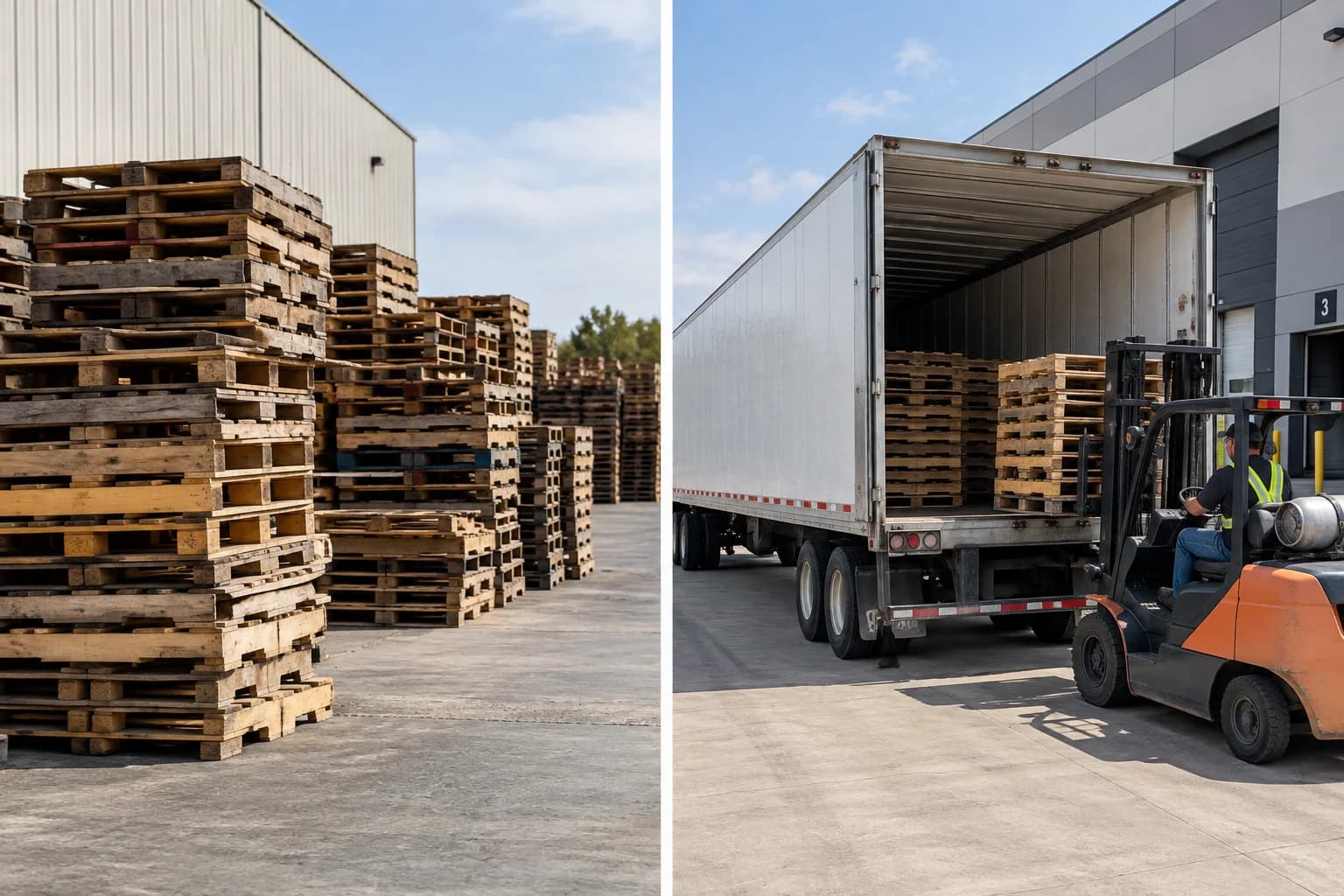
Drop trailer pallet recycling works best when warehouse teams treat the trailer as part of the daily loading dock workflow. Employees move eligible wood pallets into an enclosed trailer as they accumulate. Once the trailer reaches capacity, the pallet service provider picks it up and replaces it with an empty one. This creates a consistent path from the warehouse floor to pallet removal without relying on repeated one-time pickup requests.
At The Pallet Squad, we work with warehouses, distribution centers, manufacturers, food distribution operations, and other high-volume facilities that regularly generate excess pallets. The trailer handles the storage and removal side of the process, while a clear internal routine keeps pallets moving in the right direction.
Why the Loading Dock Workflow Matters
A drop trailer gives excess pallets a destination, but the trailer alone doesn’t determine how efficiently employees use it.
Without a defined routine, pallets may still collect near receiving doors, get mixed with active pallet inventory, or sit in staging areas until someone has time to move them. Employees may also disagree about which pallets belong in the trailer or who should report that it’s nearly full.
A simple workflow answers those questions before they interrupt the shift. It should identify:
- Where employees place pallets before loading
- Which pallets belong in the recycling stream
- Who moves them into the trailer
- How the team monitors trailer capacity
- Who requests the next pickup or swap
The process doesn’t need to create a large administrative project. It needs to fit the way pallets already move through the facility.
Start With the Pallet’s Point of Origin
Follow the path of an empty pallet through the operation. Depending on the facility, pallets may enter the recycling stream at receiving, replenishment, production, order picking, repacking, or outbound shipping.
If several departments generate excess pallets, each area needs a clear route to the same collection process. Otherwise, employees will move pallets wherever they find room.
Walk the facility during a normal shift and note where stacks begin forming. Pay particular attention to crowded dock doors, corners used for temporary staging, and areas where employees separate damaged pallets from usable inventory.
These observations show where the workflow breaks down. A stack near receiving may indicate that employees don’t know where to take empty pallets. A crowded staging lane may mean the transfer to the trailer happens too infrequently. Pallets left outside may point to unclear ownership between departments.
Choose a Controlled Staging Area
Some facilities move pallets directly into the trailer. Others need a short-term staging point because of staffing, equipment access, or dock activity.
If your operation needs staging, choose one controlled location close to the trailer route. Keep the area away from emergency exits, active dock edges, pedestrian paths, and lanes used by forklifts or pallet jacks.
The staging area should hold only the amount your team expects to move during a reasonable part of the shift. An oversized area often becomes long-term storage, which defeats the purpose of creating a steady removal flow.
Clear aisles matter for safety as well as efficiency. OSHA’s materials-handling standard requires sufficient clearance where mechanical equipment operates and calls for aisles and passageways to remain clear and unobstructed. Each facility should incorporate its own safety policies, equipment rules, and site conditions into the final layout.
Decide Which Pallets Enter the Trailer
Employees need straightforward instructions about what belongs in the pallet trailer. Avoid leaving this decision to individual judgment during a busy shift.
Before service begins, discuss the pallet sizes, conditions, ownership, and quantities your facility generates. Some reusable pallets may qualify for purchase, while others may qualify for haul-off or recycling. Pallets owned by another company shouldn’t enter the program without authorization.
The Pallet Squad reviews the details before determining the appropriate service arrangement. Businesses with reusable inventory can also review our information about selling used wood pallets.
Once the requirements are clear, give warehouse employees a short internal standard they can follow. Supervisors should also name a person who handles unusual pallets rather than allowing questionable material to enter the normal stream.
Assign Ownership by Shift
Pallet removal often stalls because everyone assumes another department owns it.
Assign the responsibility to a specific role on each shift. One operation might make it part of the receiving team’s closing routine. Another may assign it to a material handler who already travels between production and the dock.
The person doesn’t need to manage the entire recycling program alone. Their job may simply include checking the staging area, moving eligible pallets into the trailer, and reporting when the trailer approaches capacity.
Larger facilities may split the responsibility. Employees in each department bring pallets to the designated staging point, while the dock team handles trailer loading. That arrangement works as long as both sides know where their responsibility begins and ends.
Build Drop Trailer Pallet Recycling Into Daily Work
Waiting until excess pallets become a visible problem creates unnecessary catch-up work. A regular loading rhythm keeps the process manageable.
Consider connecting pallet movement to an existing event during the shift, such as:
- The end of a receiving window
- Completion of a production run
- A scheduled dock cleanup
- The end-of-shift equipment check
- A routine transfer between warehouse zones
The right timing depends on pallet volume and dock traffic. A busy distribution center may load the trailer throughout the day. A facility with moderate, predictable volume may handle the transfer once per shift.
Employees shouldn’t rush trailer loading or work around active freight movements. The facility’s safety procedures and equipment rules always take priority over speed.
Load With Trailer Capacity in Mind
The Pallet Squad’s drop trailer pallet recycling program uses an enclosed 53-foot semi-truck trailer with a listed capacity of up to 600 pallets. Actual use depends on the pallets being loaded and the agreed service setup.
Orderly loading uses the available trailer space more effectively and makes capacity easier to estimate. Random placement, leaning stacks, or large gaps may cause the trailer to appear full before it reaches practical capacity.
Warehouse managers should establish a loading method that accounts for their equipment, staffing, pallet types, and safety requirements. Train every employee assigned to the task on that method. Consistency matters, especially when several shifts use the same trailer.
Monitor Capacity Before the Trailer Is Full
A good swap process begins before the last pallet goes into the trailer.
Choose a simple capacity trigger that gives the appropriate contact enough time to coordinate service. Your team could check available space at the start of each shift or report capacity at a defined point in the loading process.
Avoid relying on memory or informal messages. Record the status in a shift log, warehouse management checklist, or other system the operation already uses. The update can stay brief:
- Estimated space remaining
- Date and time checked
- Person who completed the check
- Whether a swap request has started
High-volume operations should also track how quickly trailers fill. If one trailer fills much faster during seasonal peaks, the service schedule may need to reflect that change.
Prepare for Pickup and Replacement
Before a full trailer leaves, confirm that the service provider has clear access to it. Check for parked vehicles, stored materials, or other obstructions that could interfere with the exchange.
Internally, notify the employees who use the trailer so they know when a swap is expected. The team may need a temporary location for eligible pallets during the service window, particularly if pallet volume continues throughout the day.
After the empty trailer arrives, verify that the appropriate employees know it’s ready for use. That small handoff prevents pallets from continuing to collect in temporary staging after the swap.
Review the Workflow After the First Few Cycles
The first trailer cycle shows how the plan performs under real warehouse conditions. Review where pallets accumulated, whether employees followed the sorting instructions, and how accurately the team anticipated the full trailer.
Ask the people doing the work where they encountered delays. A material handler may spot a blocked route that wasn’t obvious during planning. A second-shift supervisor may find that the designated contact isn’t available when the trailer approaches capacity.
Adjust the workflow based on those observations. You may need to move the staging area, schedule more frequent transfers, clarify pallet requirements, or change who reports capacity. Small operational changes usually work better than replacing the whole process.
Set Up a Repeatable Pallet Removal Process
A reliable pallet recycling workflow gives every eligible wood pallet a clear path from the warehouse floor to the trailer. Employees know where to take it, who loads it, and what happens when the trailer fills.
The Pallet Squad coordinates drop trailer pallet recycling for qualifying warehouses, distribution centers, and other commercial facilities nationwide. We place an empty enclosed trailer at the facility, the warehouse team loads pallets as they accumulate, and we pick up and swap the trailer when it’s full.
To discuss pallet volume, facility needs, and service availability, request a pallet service quote. Before reaching out, estimate how many pallets your facility generates, how quickly they accumulate, and where a trailer could sit on-site. Those details make it easier to evaluate the right removal setup.