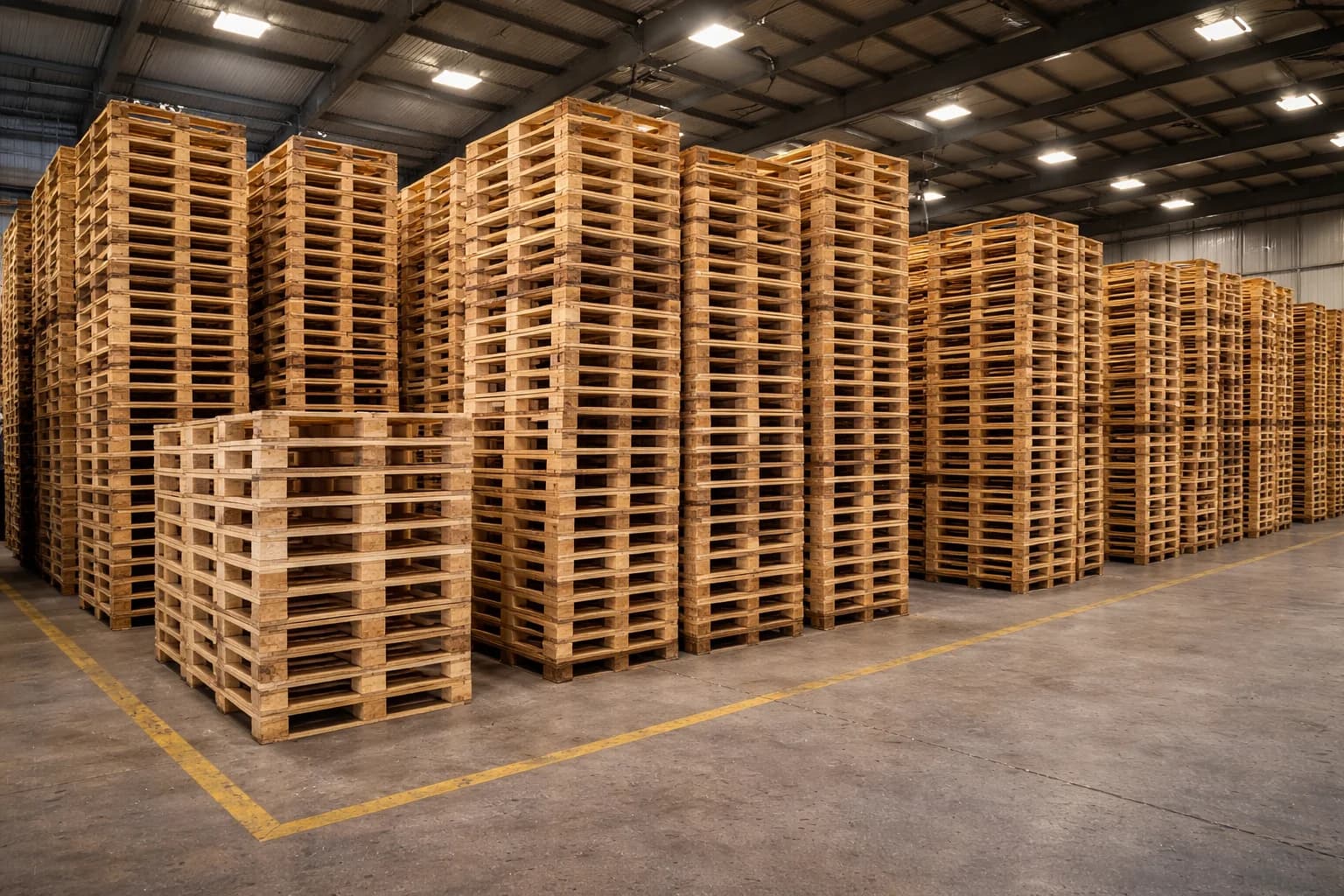
Most companies don’t think about pallets until there’s a problem. A shipment is delayed because pallets didn’t arrive on time. A yard fills up with broken stacks. Costs creep up due to emergency orders and inconsistent grades. What looked like a simple supply purchase turns into a recurring operational issue.
That’s where pallet logistics services come in.
A full-service pallet supplier does more than deliver stacks of wood. They manage flow, recovery, replenishment, and performance across your operation. Instead of reacting to shortages or clutter, pallet logistics services create a structured system that keeps inventory stable, costs predictable, and warehouses moving efficiently.
This article explains what pallet logistics services include and how full-service suppliers operate differently from basic pallet sellers.
The Difference Between Pallet Supply and Pallet Logistics Services
A traditional pallet seller focuses on transactions:
- You place an order
- They deliver pallets
- The interaction ends
A full-service pallet logistics provider focuses on systems:
- Inventory planning
- Scheduled replenishment
- Pickup and recycling
- Retrieval programs
- Multi-location coordination
- Cost and performance tracking
The difference is operational control.
1. Scheduled Replenishment Instead of Emergency Ordering
Many warehouses operate reactively, ordering pallets only when inventory runs low. This leads to:
- Rush delivery fees
- Production slowdowns
- Dock congestion
- Overtime labor
Full pallet logistics services include scheduled delivery programs, where:
- Minimum and maximum pallet levels are defined
- Deliveries occur on a predictable cadence
- Buffer inventory is maintained
- Peak demand periods are planned in advance
This approach reduces emergency buying and stabilizes freight costs.
2. Integrated Pickup and Recycling Programs
Used pallets don’t disappear, they accumulate.
Without structured removal, facilities face:
- Yard congestion
- Disposal fees
- Safety hazards
- Usable pallets mixed with scrap
Full-service pallet logistics providers include:
- Scheduled pallet pickup
- Scrap removal
- Sorting and grading
- Repair and reuse processes
- Recycling for end-of-life wood
Instead of paying to dispose of pallets, businesses maintain a clean yard and recover value from reusable inventory.
3. Pallet Retrieval Programs for Closed-Loop Recovery
If pallets leave your facility on outbound shipments, shrinkage becomes a real cost.
Pallet logistics services often include structured retrieval programs, which:
- Coordinate pickup from customer sites
- Consolidate returns
- Sort and repair pallets
- Reintroduce usable pallets into circulation
Retrieval reduces:
- Replacement purchases
- Lost inventory
- Supply instability
- Waste
For high-volume shippers, even small improvements in return rates create measurable savings.
4. Centralized Management for Multi-Location Operations
Companies operating multiple warehouses often struggle with:
- Inconsistent pallet grades
- Price variability
- Uneven inventory levels
- Duplicate suppliers
- Emergency transfers between sites
Full pallet logistics services provide:
- Centralized purchasing
- Standardized pallet specifications
- Consistent grading across locations
- Coordinated delivery schedules
- Unified reporting
This reduces administrative complexity and improves cost control at scale.
5. Standardization of Pallet Grades and Specifications
Inconsistent pallet quality causes:
- Load instability
- Freight damage
- Racking issues
- Operational confusion
A full-service supplier defines:
- Approved pallet sizes
- Acceptable grades (new, recycled, heavy-duty)
- Inspection standards
- Repair criteria
- Rejection policies
Standardization improves safety and reduces damage-related costs.
6. Data and KPI Tracking
Full pallet logistics services don’t operate blindly. They track performance.
Common pallet KPIs include:
- On-time delivery rate
- Pallet usage per week
- Shrink percentage
- Repair vs replacement rate
- Emergency order frequency
- Cost per pallet delivered
Tracking these metrics helps identify inefficiencies and continuously improve the pallet program.
7. Support for Industry-Specific Requirements
Different industries require different pallet solutions.
A full-service pallet logistics provider understands:
- Heavy-duty pallets for industrial and machinery loads
- Reinforced pallets for chemicals
- Stable pallets for furniture shipping
- Export-compliant pallets (heat-treated, ISPM 15)
- High-turn recycled pallets for distribution centers
This expertise reduces the risk of load failures and freight claims.
8. Freight Optimization and Bulk Planning
Freight cost is often a significant portion of pallet spend.
Full pallet logistics services optimize:
- Delivery routes
- Order size
- Drop trailer programs
- Bulk shipment consolidation
- Regional staging
Larger, scheduled deliveries often lower the cost per pallet and improve reliability.
9. Risk Reduction and Operational Stability
At its core, pallet logistics services reduce risk.
Risk of:
- Stockouts
- Freight damage
- Yard overflow
- Compliance failures
- Margin erosion from hidden costs
When pallet flow is structured and predictable, operations managers spend less time troubleshooting and more time focusing on throughput and efficiency.
The Strategic Advantage of Full-Service Pallet Logistics
When companies move from transactional buying to managed pallet logistics services, they gain:
- Predictable inventory levels
- Lower total cost of ownership
- Cleaner and safer yards
- Reduced shrinkage and loss
- Fewer emergency purchases
- Improved sustainability performance
Instead of pallets being a recurring operational headache, they become a controlled asset within the supply chain.
Pallets may seem simple, but managing them at scale is not. Businesses that treat pallet sourcing as a one-time purchase often face recurring shortages, inconsistent quality, and rising costs.
Pallet logistics services go beyond selling pallets. They create structured systems that manage supply, recovery, recycling, and performance across your operation.
When pallet logistics are handled proactively, your warehouse runs smoother, your freight stays stable, and your costs become predictable.
Contact The Pallet Squad
If you’re ready to move beyond basic pallet purchasing and implement structured pallet logistics services, contact The Pallet Squad to build a full-service program that supports delivery, pickup, retrieval, and multi-location inventory control.